We’ve covered this topic before — and we’ll keep returning to it. Because some numbers are too alarming to forget.
Balihara Ranch has long promoted itself as a successful, family-run kennel. But the numbers tell a different story—one that can’t be ignored.
According to data from the Slovak Club of Swiss Mountain Dogs — the official FCI breed club under which Balihara Ranch operates — between 1997 and part of 2023, the kennel produced:
- 2,557 puppies
- Across 446 litters
Visualization: 1997–2023
The graph provides a year-by-year breakdown, tracking the exact number of litters and puppies born from 1997 through the most recent data available for part of 2023.
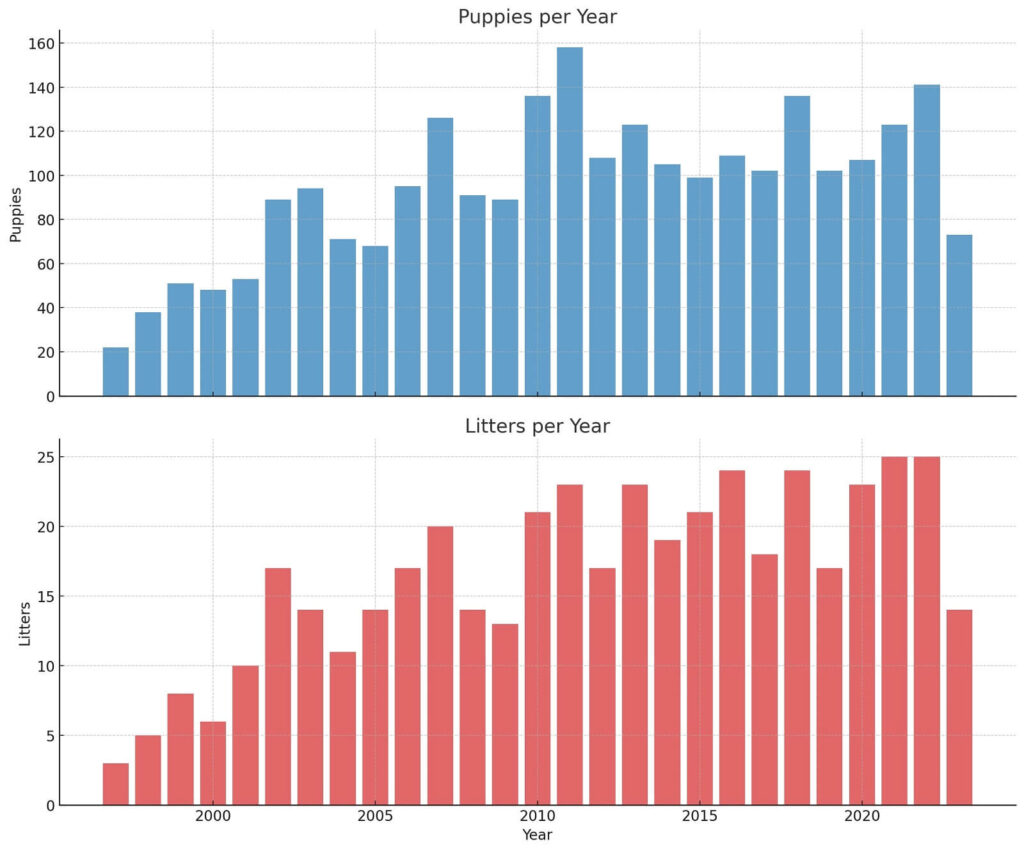
Puppies and litters at Balihara Ranch (1997–2023)
Let’s be clear:
This is not a hobby breeder. This is industrial-scale production.
What Do These Numbers Really Mean?
Let’s unpack the implications:
These figures reflect only the available data—i.e., the official Slovak Club of Swiss Mountain Dogs registry.
The Slovak Club of Swiss Mountain Dogs database starts in 1997. We have no insight into how many puppies may have been bred before that year.
And since it’s now 2025, we must add in the remaining litters from 2023, along with litters from 2024 and 2025—potentially dozens more litters and hundreds more puppies.
Additionally, these numbers only cover Swiss Mountain Dog breeds. The kennel owner also breeds other dogs (e.g., Norfolk Terriers), meaning the true totals are even higher—with hundreds of additional puppies and dozens more litters unaccounted for here.
Legal ≠ Ethical
Yes, practices like these may be technically legal under current breeding regulations.
But legal doesn’t mean ethical—especially when we’re talking about mass production of companion animals under the guise of being “family-run.”
Not a Family — A Production Line
Official paperwork may speak of “FCI pedigree certificates,” but in practice, this is mass-scale breeding.
When you imagine a responsible, family-based breeder, you think of:
- A small number of dogs raised in a home environment
- Thoughtfully spaced-out litters
- A focus on early socialization
- Direct and regular communication with puppy buyers
But what do we see here instead?
- 2,557 puppies across 446 litters
- Dozens of new breeding dogs registered every single year
- Puppies sold through third-party brokers
- Dogs ending up in puppy mills with documented welfare violations
This isn’t a breeding program driven by passion or care.
This is a canine assembly line.
Final Thoughts
Numbers don’t lie—and these numbers are public.
Over the course of 30 years, the owner of Balihara Ranch has personally bred thousands of puppies, from hundreds of litters, using dozens of breeding females, many of whom were bred repeatedly until exhaustion.
This isn’t an accident. It’s not a one-time oversight.
It’s a long-standing, systematic business model.
So we have to ask:
Is this still a “labor of love”?
Or has the dog become just another product?
All figures cited are based on publicly available data. For full methodology and sources, see the disclaimer on the main page.