
Today, we are publishing an open letter addressed to the owner of Balihara Ranch.
Why?
Because on social media, she labeled our website a “scam.”
We have therefore chosen to respond directly and transparently.
In this letter, we present seven specific, documented claims.
If the owner of Balihara Ranch can prove that even one of them is untrue, we commit to taking down our entire website immediately.
That’s not what a “hater” does.
That’s what someone with a clear conscience does.
This is not a personal attack.
This is a challenge built on verifiable, publicly available facts.
Until we receive a response, silence is all that remains.
And silence—in cases like this—speaks louder than a thousand words.
Dogs cannot defend themselves.
That is why we speak for them.
And that is why her silence is not merely her choice.
It is her admission.
Here is the entire letter we sent to the owner of Balihara Ranch:
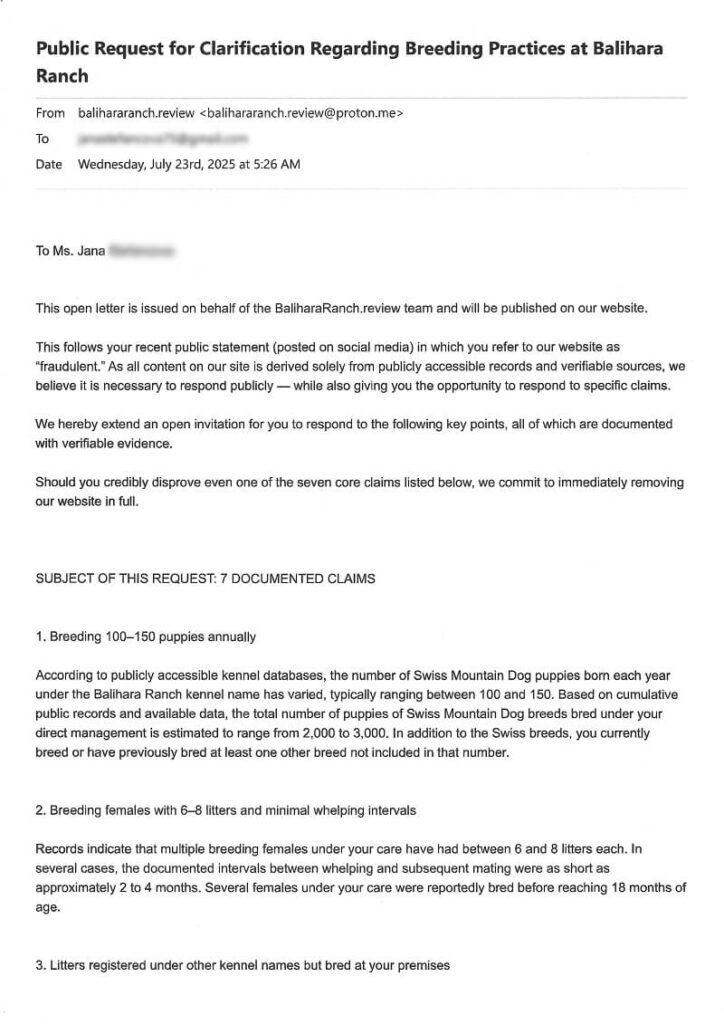
Subject: Public Request for Clarification Regarding Breeding Practices at Balihara Ranch
To Ms. Jana S.
This open letter is issued on behalf of the BaliharaRanch.review team and will be published on our website.
This follows your recent public statement (posted on social media) in which you refer to our website as “fraudulent.” As all content on our site is derived solely from publicly accessible records and verifiable sources, we believe it is necessary to respond publicly — while also giving you the opportunity to respond to specific claims.
We hereby extend an open invitation for you to respond to the following key points, all of which are documented with verifiable evidence.
Should you credibly disprove even one of the seven core claims listed below, we commit to immediately removing our website in full.
SUBJECT OF THIS REQUEST: 7 DOCUMENTED CLAIMS
- Breeding 100–150 puppies annually
According to publicly accessible kennel databases, the number of Swiss Mountain Dog puppies born each year under the Balihara Ranch kennel name has varied, typically ranging between 100 and 150. Based on cumulative public records and available data, the total number of puppies of Swiss Mountain Dog breeds bred under your direct management is estimated to range from 2,000 to 3,000. In addition to the Swiss breeds, you currently breed or have previously bred at least one other breed not included in that number.
- Breeding females with 6–8 litters and minimal whelping intervals
Records indicate that multiple breeding females under your care have had between 6 and 8 litters each. In several cases, the documented intervals between whelping and subsequent mating were as short as approximately 2 to 4 months. Several females under your care were reportedly bred before reaching 18 months of age.
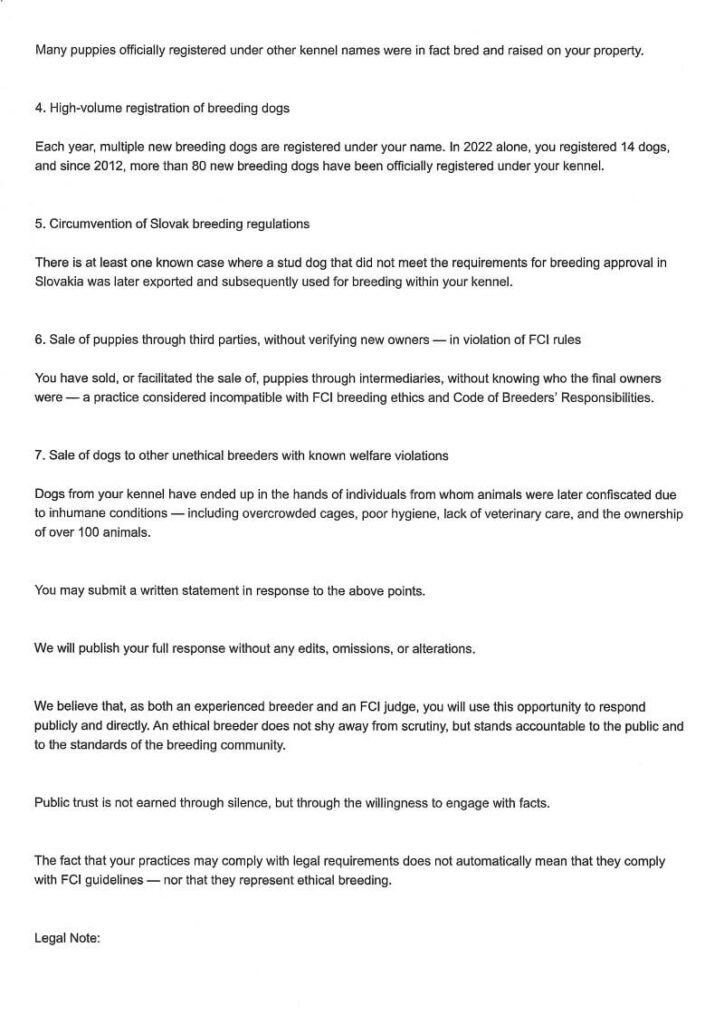
- Litters registered under other kennel names but bred at your premises
Many puppies officially registered under other kennel names were in fact bred and raised on your property.
- High-volume registration of breeding dogs
Each year, multiple new breeding dogs are registered under your name. In 2022 alone, you registered 14 dogs, and since 2012, more than 80 new breeding dogs have been officially registered under your kennel.
- Circumvention of Slovak breeding regulations
There is at least one known case where a stud dog that did not meet the requirements for breeding approval in Slovakia was later exported and subsequently used for breeding within your kennel.
- Sale of puppies through third parties, without verifying new owners — in violation of FCI rules
You have sold, or facilitated the sale of, puppies through intermediaries, without knowing who the final owners were — a practice considered incompatible with FCI breeding ethics and Code of Breeders’ Responsibilities.
- Sale of dogs to other unethical breeders with known welfare violations
Dogs from your kennel have ended up in the hands of individuals from whom animals were later confiscated due to inhumane conditions — including overcrowded cages, poor hygiene, lack of veterinary care, and the ownership of over 100 animals.
You may submit a written statement in response to the above points.
We will publish your full response without any edits, omissions, or alterations.
We believe that, as both an experienced breeder and an FCI judge, you will use this opportunity to respond publicly and directly. An ethical breeder does not shy away from scrutiny, but stands accountable to the public and to the standards of the breeding community.
Public trust is not earned through silence, but through the willingness to engage with facts.
The fact that your practices may comply with legal requirements does not automatically mean that they comply with FCI guidelines — nor that they represent ethical breeding.
Legal Note:
This letter has been prepared in full accordance with the right to free expression, freedom of speech, and legitimate investigative activity. It is based exclusively on publicly available and verifiable data.
Our intention is not to cause harm, but to protect innocent animals, inform the public, and provide you with a fair and transparent opportunity to respond.
All statements have been made with the utmost care and a strong commitment to accuracy. Should any of the claims presented on our website prove to be inaccurate, they will be promptly corrected or removed in full.
BaliharaRanch.review