
In the world of dog breeding, ethical practices are of the utmost importance. However, not all breeders adhere to these standards. One such example is the kennel Balihara Ranch.
The Temperament Issue
We have previously highlighted the poor temperaments of multiple dogs that Balihara Ranch breeds and owns, including Entlebucher Mountain Dogs, FEEBEE from the Earths’s Axis, D’ARTAGNAN Zahrada Snu, or Appenzeller Mountain Dog DAISY. However, the issue with poor temperament tests extends beyond these smaller breeds of Swiss mountain dogs.
Take, for instance, the Greater Swiss Mountain Dog female, KLÄRCHEN vom Schwoaten Pad. This female scored a measly 10 points in temperament tests, a clear indication of her fearful temperament. In the pictures, Klarchen can be seen with her tail tucked under her belly, a classic sign of fear. Additionally, the female also has a significantly translucent undercoat.
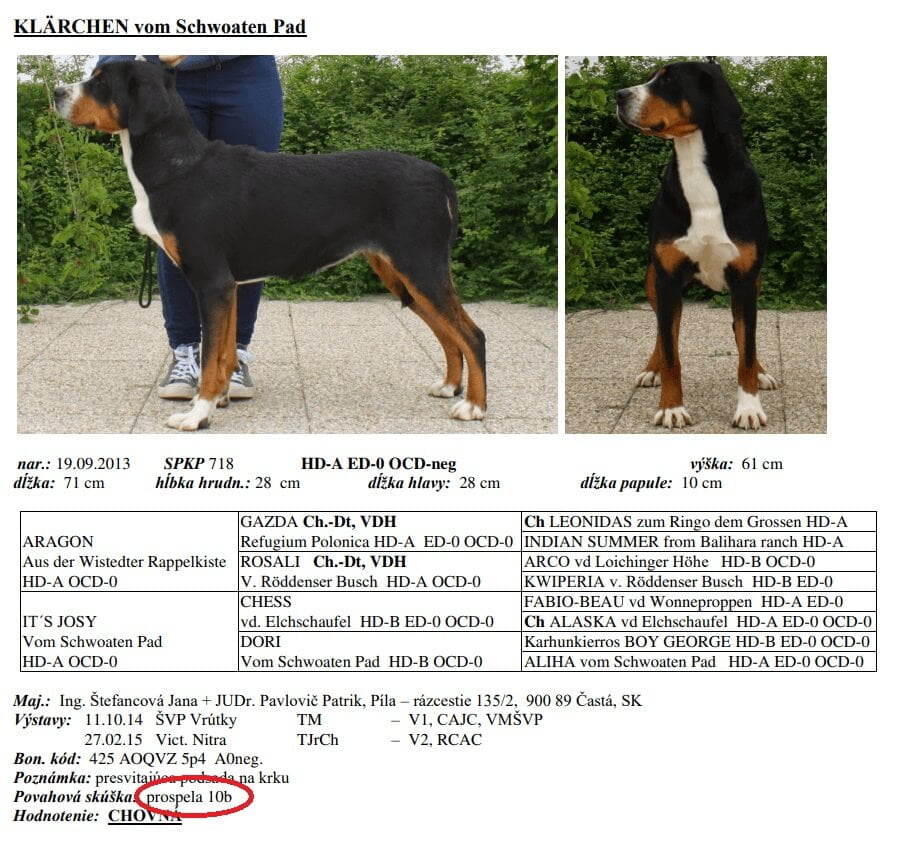
source: skssp.eu
Unethical Breeding Practices
Many ethical breeders would hesitate to breed a dog with such characteristics. However, Balihara Ranch bred Klarchen four times, resulting in a total of 32 puppies. This practice raises serious ethical questions.
Further compounding the issue is the fact that Balihara Ranch mated Klarchen three times with the same dog, Sennenhund Rossii INFERNO. This pairing resulted in a total of 26 puppies, demonstrating a lack of breeding variability.
Balihara Ranch also bred one litter with Klarchen with her own dog, ELVIS vom Försterrain, who also had very poor temperament tests, scoring only 11 points.
Overbreeding and Lack of Recovery Time
Despite having “only” four litters according to the local breeding club’s statistics (compared to Balihara Ranch’s standard unethical practices of multiple litters on one female), Klarchen did not have an easy life. Her first litter was born when she was less than two years old, having been mated at just 20 months. This early mating is a clear example of Balihara Ranch’s disregard for the health and well-being of its dogs. We have already written an article about early matings at Balihara Ranch.
Balihara Ranch owner’s greed for selling puppies seems to have won over common sense. After Klarchen gave birth to a litter of eight puppies on June 21, 2017, Balihara Ranch mated her again without allowing for the necessary recovery time. Another litter of eight puppies was born on January 11, 2018. Given that a female dog takes care of her puppies for about two months from birth and that puppies are born about two months after mating, Klarchen had less than three months to recover after giving birth. We have already written an article about short breaks between litters at Balihara Ranch.
Conclusion
These practices accurately characterize the perversion of the Balihara Ranch owner’s breeding program at the Balihara Ranch kennel. It is a stark reminder of the importance of ethical breeding practices and the need for potential dog owners to thoroughly research breeders before purchasing a puppy.