The Balihara Ranch breeding kennel is once again under serious scrutiny from the breeder community. New evidence suggests that this kennel has systematically bypassed breeding regulations. This time, the focus is on another shocking case that went unnoticed for years—Dale Gudbrand’s NORWAY DREAM MACH, a Bernese Mountain Dog, was used for breeding despite a congenital dentition anomaly that rendered him ineligible for breeding approval in Slovakia, where Balihara Ranch’s owner operates.

source: facebook.com
To avoid repercussions, the kennel’s owner allegedly “exported” the dog on paper to a country where this defect was not monitored while continuing to use him extensively for breeding. This raises serious concerns about the credibility of this kennel.
Questionable Inclusion in Breeding Programs
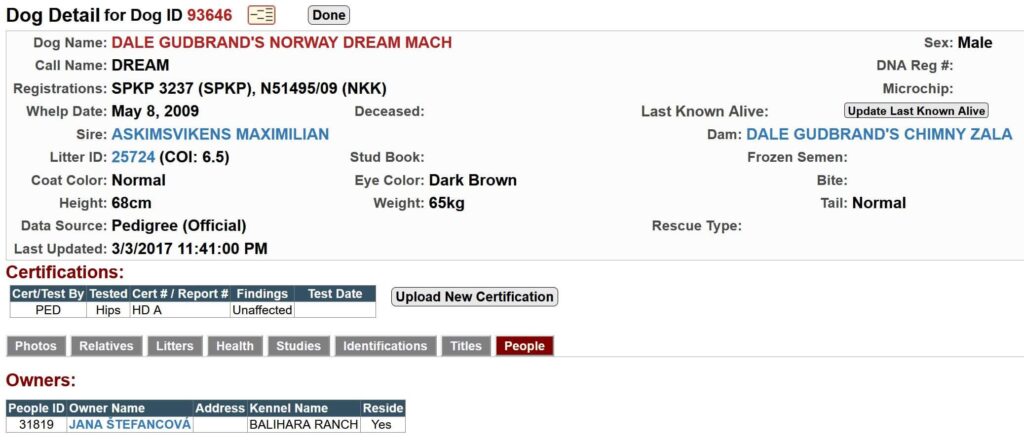
According to multiple sources, Dale Gudbrand’s NORWAY DREAM MACH had a disqualifying dentition defect that should have prevented him from being approved for breeding. Consequently, he was never officially certified for breeding in Slovakia. Under standard regulations, this alone should have disqualified him from any breeding program.
source: bernergarde.com
However, this dog was frequently used for breeding within the Balihara Ranch kennel. Records suggest that he was administratively “exported” to Poland, where this defect was not monitored. This move allowed him to pass breeding approval and be extensively used for stud purposes, bypassing Slovak breeding regulations.
source: pedigreedex.com
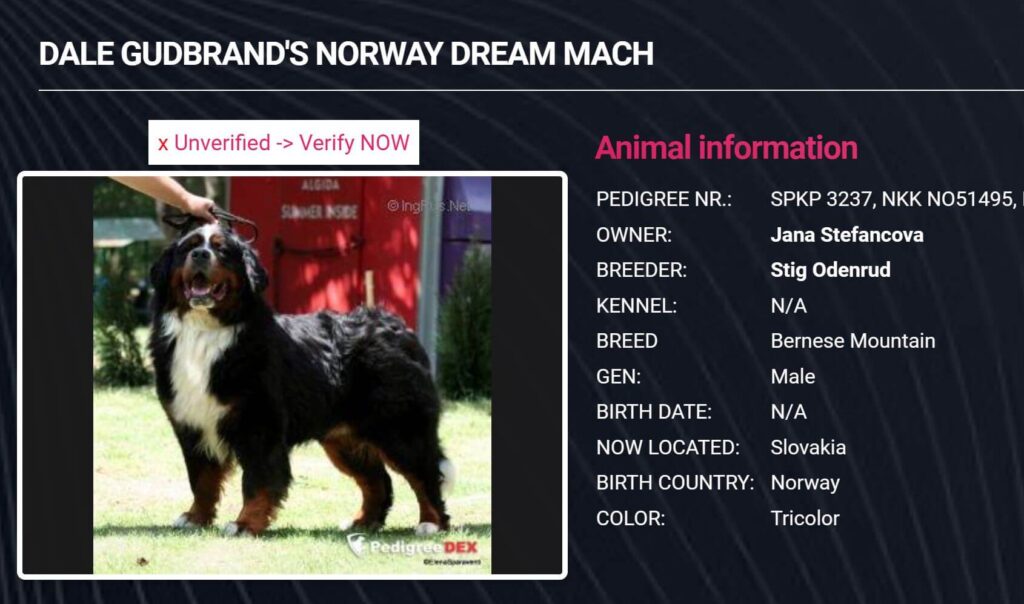
At a Slovak Swiss Mountain Dog Club exhibition in 2012, the dog was listed as co-owned with breeder Beata Jonak. Despite being used primarily within Balihara Ranch and its closely affiliated kennel, Cursalagh’s, records indicate only two foreign breedings—one with von Romanshof (Poland) and another with di Fanum Fortunae.
Unethical Breeding Practices
“Norway” became one of the most frequently used sires at Balihara Ranch, fathering an astonishing 113 puppies within a single kennel. Notably, he was bred with only four females, creating an extremely narrow genetic base among his offspring and increasing the risk of inherited disorders.
Here’s a breakdown of the females bred with “Norway” at Balihara Ranch:
- ESSY BLOUSSOM von Bernice Love – 2 litters, 12 puppies
- LEONTYNNE van’t Stokerybos – 4 litters, 19 puppies
- YASMIENNE from Balihara Ranch – 6 litters, 45 puppies
- YOLEEN from Balihara Ranch – 4 litters, 37 puppies
Adding to the concern, his daughter, VOULEZ VOUS from Balihara Ranch, became the most heavily bred female, producing eight litters with 64 puppies. These statistics raise serious concerns about genetic diversity and the long-term sustainability of such breeding practices.
Were Puppy Owners Informed About Potential Issues?
One major unresolved question remains: Were the owners of the 176 puppies from Norway and his daughter, Voulez Vous—born exclusively in Balihara Ranch—ever informed that their dogs came from a lineage that should never have been approved for breeding? Did they receive an honest disclosure of the risks and consequences?
At the Slovak Swiss Mountain Dog Club’s exhibition on May 24, 2014, Norway’s son, CURSALLAGH’S HE’S A DREAM, owned by Balihara Ranch, was registered but neither judged nor exhibited before mysteriously disappearing from breeding records. Was he excluded because he carried the same defect as his father? What happened when he was deemed unfit for Balihara Ranch’s breeding program?
Similarly, Norway’s daughter BALLYHARA’S VIVIENNE was officially evaluated for breeding but never produced any litters. Voulez Vous, entered into the club show on May 23, 2018, was never presented or evaluated. At the Specialty Show on October 3, 2015, she received a lowered rating, suggesting she was not of elite show quality.
A Disturbing Pattern: The Qaiser van’t Stokerybos Parallel
When this case is examined alongside the Qaiser van’t Stokerybos controversy, a disturbing pattern emerges.
How many more dogs have been secretly “exported” by the owner of Balihara Ranch to bypass breeding regulations, only to be bred without ethical considerations? How many defective dogs have been quietly approved for breeding under the radar?
Both cases raise serious concerns about potential violations of FCI regulations. These practices suggest a systemic issue within Balihara Ranch.
Consequences for Breeding Ethics & Regulation
These cases strongly indicate systemic rule-breaking. If FCI and national breeding clubs fail to intervene, similar cases will continue to emerge.
Dogs that should have been disqualified from breeding in their home country were simply “relocated” to places where they could pass approval—then extensively bred. How has Balihara Ranch managed to circumvent breeding regulations, especially when its owner is an international dog show judge?
Conclusion: A Call for Transparency
This case is no longer about a single dog—it’s about a system that enables rule-breaking, disregards ethics, and misleads breeders.
A failure to act by FCI and breeding clubs would signal that such unethical practices are acceptable—a dangerous precedent for responsible breeders.
With growing concerns about breeding ethics, it is time to demand greater transparency and stricter oversight in the breeding industry.
Whether you are a future puppy owner or an experienced breeder, always research a dog’s lineage thoroughly. If a dog comes from a background where rules are ignored, the genetic and health consequences could be far worse than expected—and you may only realize this when it’s too late.