For years, the owner of Balihara Ranch has insisted she has nothing to do with other kennel operations. According to her, puppies registered under different kennel names had no connection to her breeding program.
But the internet archive tells a different story—not through hearsay, but from the owner’s own public statements.
Back in 2011–2012, she openly admitted on Facebook that litters registered under other kennel names were actually whelped and raised on her property.
What Did She Write?
- September 2011: “Balihara Ranch and Ballyhara’s – Swiss Mountain Dogs.”
Here she directly linked two kennel names, presenting them together as “our kennels.” - February 2012: “No more Ballyhara’s… but he has the new kennel name Cursallagh’s – Swiss Mountain Dogs living at Balihara Ranch.”
In plain terms: puppies carrying Cursallagh’s pedigrees were actually bred and reared on Balihara Ranch.
Direct Evidence
And it’s not just words—there are screenshots directly from the official Facebook page of the Balihara Ranch owner (2011–2012):
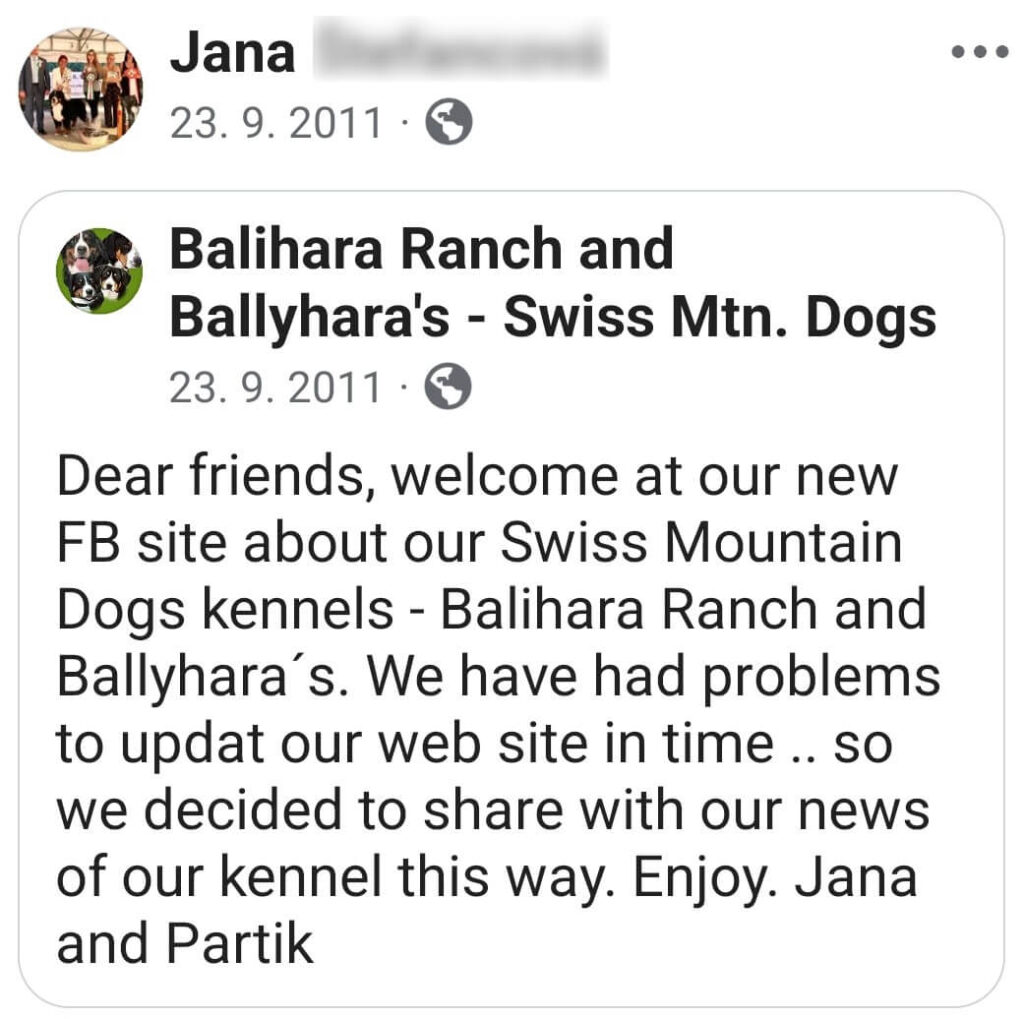
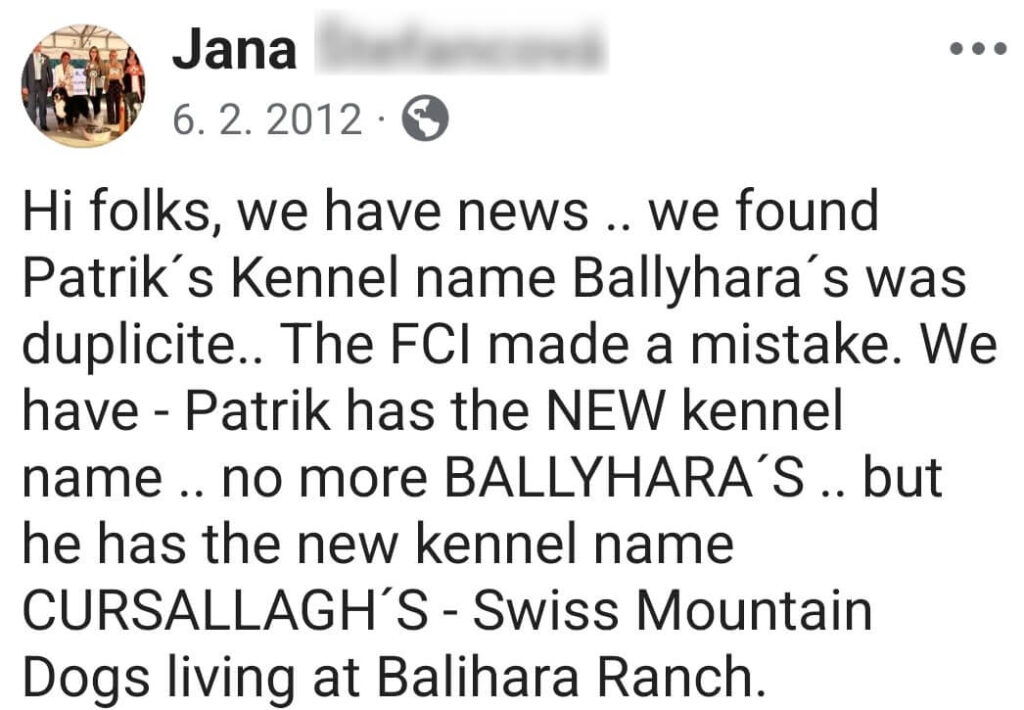
These posts make it clear: litters carrying other kennel names were born and raised on Balihara Ranch.
What Does It Mean?
- The owner of Balihara Ranch herself confirmed that multiple kennel names were nothing more than different masks for the same production.
- And yet, every single dog was raised on Balihara Ranch.
That isn’t true transparency. It’s a long-term masking tactic designed to obscure the true scale of the operation.
Why Is This a Problem?
Because both FCI regulations and basic breeding ethics are crystal clear:
- Every breeder is accountable under their own registered kennel name.
- Transparency is the foundation of trust.
When litters are produced under various kennel names, accurate tracking of numbers, conditions, and breeding frequency becomes impossible. And the figures from Balihara Ranch are staggering—hundreds of litters, hundreds of breeding dogs, and thousands of puppies produced.
Why Multiple Kennel Names?
The purpose seems obvious: to disguise the real scope of production.
On paper, it looks less conspicuous.
In reality, it’s the same property, the same dogs, the same “assembly line.”
The Reality Behind the Names
Whether the dogs were sold under Ballyhara’s, Cursallagh’s, or other kennel names, they all grew up in the same environment, on the same property, under the same management.
Today, the owner of Balihara Ranch presents herself as running a “family breeding program, born out of love.”
But these past statements tell another story: the names may change, but the breeding practices remain exactly the same.
Why Does This Matter?
Because it reveals a system that continues to this day: when one kennel name gets worn out, another takes its place.
What does that mean in practice?
- Puppy buyers often have no idea where their dog truly comes from.
- The number of litters is split across multiple kennel names, concealing the real scale of production.
- And the reality stands in stark contrast to the outward image of a “family breeder.”
What About Today?
We are now tracking Balihara Ranch’s links to yet another kennel.
Available data suggest that the same masking and deception are still in play—using the same methods:
- overbreeding females without sufficient recovery periods,
- breeding females before they were physically mature.
We will cover this in detail in a separate article once we gather sufficient evidence.
Conclusion
A transparent breeder has nothing to hide.
If the program is ethical and sound, one name is enough.
When a single operation functions under multiple identities, it’s not “tradition.”
It’s deception. It’s a system designed to conceal what the public was never meant to see.